About
Press
Imprint
Login
Home
Login
ABOUT
PRESS
IMPRINT
Home
Archive
Sheets
19780160
Sheet 19780160
Type:
Positive
,
Negative
,
Digital
Color:
Black & White
Country:
Mexico
Region:
Monte Alban
Place:
Mitla
Date:
Jan 1, 1978
Keywords:
Kultur
Architektur
Ortschaften
8
12
13
14
15
17
17
17
20
21

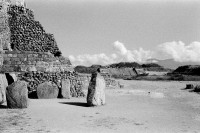
![Image of sheet 19780160 photo 12: Mitla is the second most important archeological site in the state of Oaxaca in Mexico, and the most important of the Zapotec culture [citation needed] The site is located 44 km from the city of Oaxaca in the upper end of the Tlacolula Valley, one of the three that form the Central Valleys Region of the state. The archeological site is within the modern municipality of San Pablo Villa de Mitla. While Monte Albán was most important as the political center, Mitla was the main religious center. The name Mitla is derived from the Nahuatl name Mictlán, which was the place of the dead or underworld. Its Zapotec name is Lyobaa, which means «place of rest» The name Mictlán was Hispanicized to Mitla by the Spanish. However, what makes Mitla unique among Mesoamerican sites is the elaborate and intricate mosaic fretwork and geometric designs that cover tombs, panels, friezes and even entire walls. These mosaics are made with small, finely cut and polished stone pieces which have been fitted together without the use of mortar. No other site in Mexico has this. Mexico 1978](https://oliviaheussler.com/storage/photos/19780160-12/thumbnails/19780160_12.jpg)
![Image of sheet 19780160 photo 13: Mitla, Monte Alban, (Zapotekische Kultur) Zapotheken um 1250. dann kamen die Mixteken.
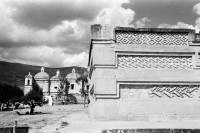
Mitla is the second most important archeological site in the state of Oaxaca in Mexico, and the most important of the Zapotec culture [citation needed] The site is located 44 km from the city of Oaxaca in the upper end of the Tlacolula Valley, one of the three that form the Central Valleys Region of the state. The archeological site is within the modern municipality of San Pablo Villa de Mitla. While Monte Albán was most important as the political center, Mitla was the main religious center. The name Mitla is derived from the Nahuatl name Mictlán, which was the place of the dead or underworld. Its Zapotec name is Lyobaa, which means «place of rest» The name Mictlán was Hispanicized to Mitla by the Spanish. However, what makes Mitla unique among Mesoamerican sites is the elaborate and intricate mosaic fretwork and geometric designs that cover tombs, panels, friezes and even entire walls. These mosaics are made with small, finely cut and polished stone pieces which have been fitted together without the use of mortar. No other site in Mexico has this. Mexico 1978](https://oliviaheussler.com/storage/photos/19780160-13/thumbnails/19780160_13.jpg)
![Image of sheet 19780160 photo 14: Mitla, Monte Alban, (Zapotekische Kultur) Zapotheken um 1250. dann kamen die Mixteken.
Mitla is the second most important archeological site in the state of Oaxaca in Mexico, and the most important of the Zapotec culture [citation needed] The site is located 44 km from the city of Oaxaca in the upper end of the Tlacolula Valley, one of the three that form the Central Valleys Region of the state. The archeological site is within the modern municipality of San Pablo Villa de Mitla. While Monte Albán was most important as the political center, Mitla was the main religious center. The name Mitla is derived from the Nahuatl name Mictlán, which was the place of the dead or underworld. Its Zapotec name is Lyobaa, which means «place of rest» The name Mictlán was Hispanicized to Mitla by the Spanish. However, what makes Mitla unique among Mesoamerican sites is the elaborate and intricate mosaic fretwork and geometric designs that cover tombs, panels, friezes and even entire walls. These mosaics are made with small, finely cut and polished stone pieces which have been fitted together without the use of mortar. No other site in Mexico has this. Mexico 1978](https://oliviaheussler.com/storage/photos/19780160-14/thumbnails/19780160_14.jpg)